
 Education

Did you do a jigsaw puzzle this summer? Or roll a die in a board game? Probably. But when was the last time you connected that puzzle and dice game to computational thinking?
Computational thinking (CT) doesn’t mean coding or computers. CT is a way to think about solving a problem. A puzzle is a problem to be solved. You know from the box cover it is a picture of the Eiffel Tower, but you have 1,000 cardboard pieces. The final picture is your answer, and you need to figure out how to solve it. How do you tackle what might seem like an overwhelming challenge?
You and your students use computational thinking skills to get there. This can include:
- Problem Decomposition: Breaking down a problem or task into smaller, more manageable parts
- Pattern Recognition and abstraction: Seeing repeated patterns in types of problems and solutions and generalizing them into categories
- Algorithm Design: Designing a sequence of steps to solve the problem, or parts of the problem

Hands On & Digital Learning
Activities like puzzle completion can be used in classrooms (or living rooms!) to introduce and discuss CT and CT vocabulary. Spread out some puzzles and give students time in small groups to tackle them. Then, ask your students to think about what they did. Maybe they decomposed the problem by doing edge pieces first. Maybe they grouped pieces by colors and patterns. And maybe they devised a series of steps such as:
- First turning all the pieces face up
- Then sorting by edge vs. middle; color; shape
- Next assembling just the straight edge or distinctive part of the image
They’ve discovered how to take a larger problem and break it into smaller pieces, recognize and general patterns, and develop an algorithm. Your students are doing CT!
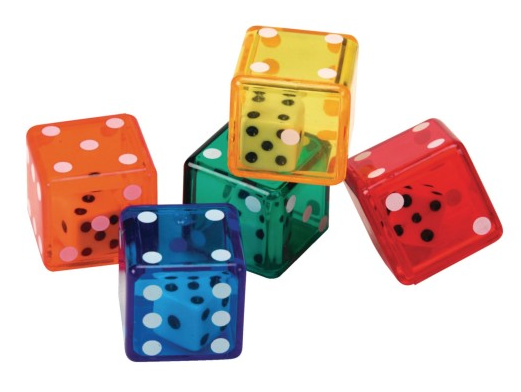
And the dice from games? Your students can design an algorithm that uses the types of logic used in CT. They use conditionals, which refers to if-then-else statements that could be a part of the series.
Example: If I visit the S&S blog, then I will learn from other great educators. You can introduce and reinforce the idea of conditionals with students by getting out the dice and starting to roll. Create starter rules for the class. For example, “If I roll less than 4, then I get 2 points. Else, I get 0 points.” Students can create their own “rules” and test on themselves or a classmate.
EdGE at TERC‘s team develops digital and offline activities for teachers, parents, and students to engage learners in CT. Our INFACT study is exploring ways to assess CT practices.
Children in grades 3-8 can help with this educational research by playing about 30-40 minutes of online logic games and puzzles, and teachers can get early access to innovative materials and assessments for their students.There are opportunities for teacher involvement from now through the 2021/22 school year. It’s productive screen time all around.
Please email [email protected] or visit our page for more information.
About the Organization:
The Educational Gaming Environments group (EdGE) at TERC designs and researches STEM-learning games and technology tools for differentiated and adaptive learning.
TERC is a nonprofit made up of teams of math and science education and research experts dedicated to innovation and creative problem solving. At the frontier of theory and practice, TERC’s work encompasses research, content and curriculum development, technology innovation, professional development, and program evaluation. TERC has a passion for social justice and strives to create level playing fields for all learners, reaching more than three million students every year.
To learn more, please visit www.terc.edu/edge.
-
Hi! I’d love to be able to update this for our upcoming fall study! Please reach out.



Leave a Reply