
 Fall
Fall
Halloween is a great time of year to introduce some fun lessons, excite and motivate students to stay active, share facts about the body and health related information, and display all of the important elements of your PE program! We’ve shared a few Halloween themed ideas below from our PE Halloween Guide, where you can find over 100 bulletin board ideas and lesson plans, including a dance video on how to teach the Thriller dance. View the full PE Halloween Guide here.
Bulletin Board Ideas for Halloween
Caught Exercising
Suggested Grade Level: K-2
Materials: Spider Web, Fuzzy Border with Spiders, 2 Big Spiders, Pictures of students
exercising in the gym
Description: “Caught Exercising” is our October theme bulletin board that illustrates the variety of exercise stations our students participated in on Fun Friday Station Day. Students are displayed in the spider web showing proper execution of each station.
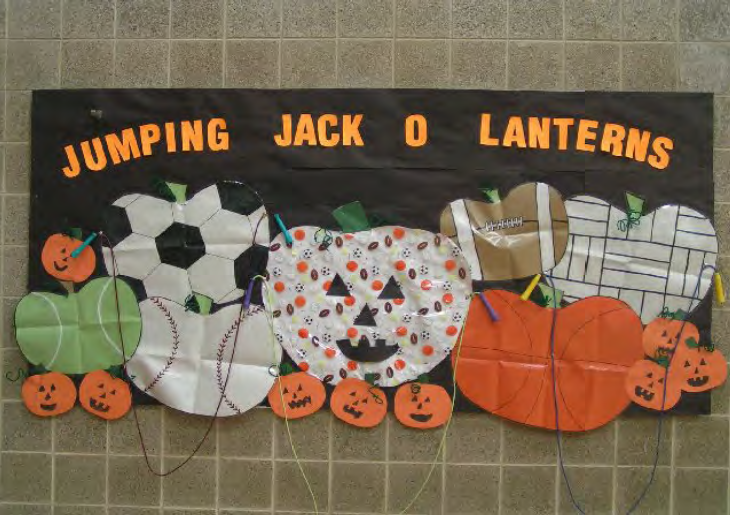
Jumping Jack O Lanterns
Suggested Grade Level: 2-5
Materials: Ellison letters, construction paper, jump ropes, paint, markers
Description: This fun bulletin board is perfect for October. I made pumpkins look like all the different sports our kids might play. Tennis, basketball, football, soccer, volleyball and baseball. I also made a pumpkin that was multi-sport (I used cellophane). I attached old jump ropes to the pumpkins to include the sport of jump rope. An alternate title I have used in the past has been “P.E. Pumpkin Patch”.
Additional Information: All pumpkins were hand drawn and cut. Use appropriate colored paper (white paper for soccer ball then black marker or green paper for tennis ball with white paint).
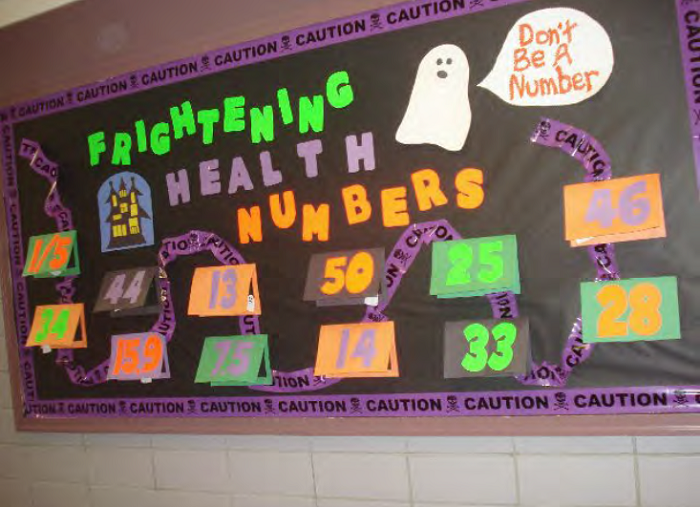
Frightening Numbers of Health
Suggested Grade Level: 9-12
Materials: Construction paper, poster board, caution tape
Description: I built this bulletin board for my first placement for field experience. I wanted the board to be informational but attention grabbing. Since was close to Halloween, I thought it would be appropriate to incorporate Halloween and frightening statistics. If you lift up the numbers, there is a health statistic that is related to teenage health. For example, underneath the 46, it says that 46% of teenagers admit to texting while driving.
Halloween Lesson and Activity Ideas
Trick Or Treat
- Suggested Grade Level: K-2
- Purpose of Activity: Students will enjoy a Halloween-themed activity while practicing the locomotor skills of run, skip, jump, gallop, dance, and walk (like a zombie.)
- Prerequisites: Students have been taught the locomotor skills.
- Materials Needed: Flashlights, cones, beanbags and Halloween music.
Set Up: The gym is darkened to facilitate the use of flashlights. Cones are set up at one end of the gym to represent the trick or treat houses. A pile of beanbags is next to each house. Depending on the size of the class, there should be two cones for every group of three students. One student will start out sitting between two cones, handing out treats (beanbags) while the other two take turns going to the house for treats.
Directions: Tell students that you will be calling out different Halloween characters, and on the signal, they will enact that costume with a corresponding locomotor skill: Cowboy – gallop, Rabbit – jump, Ballerina – dance, Speed Racer – run, Scarecrow – skip, and Zombie – walk. Before the game begins, one beanbag should be placed under one of the two cones at each house. The trick-ortreaters for each house will take turns using the flashlight to go to the house, and will have to try to guess which cone has the treat under it. If they guess correctly, they get to take the treat back with them. If they guess incorrectly, they are “tricked” and go back empty-handed. The flashlight is used as a baton, so upon return, the flashlight is handed to the partner to take a turn. The “house” continues to put beanbags under the cones until the lights come on and the music stops. Rotate positions so the student who is handing out the treats has a turn being the trick-or-treater. Have students count the number of beanbags collected after each round, to see if they had better luck guessing as the game continued. This is also good counting practice!
Assessment Ideas: Use a motor checklist to assess the level of each skill performed: rudimentary, functional, or mature.
Pumpkin Patch
- Suggested Grade Level: 3-5
- Purpose of Activity: To provide students with additional practice jumping rope.
- Prerequisites: Jump rope skills must have been practiced/taught like basic double bounce, single bounce, 1 foot, backwards jumping, straddle jumps, skier jumps, stride jumps, single side swing, double side swing, and bell jump.
- Materials Needed: Orange pumpkin cut-outs with the jump rope skills and the number of repetitions written on them.
Directions: Place a large hoop in the center of the activity area for the pumpkin patch. Place the pumpkins face down inside of the hoop. Each student should have a jump rope. As the students enter the gym hand them a pumpkin card that contain a jump rope skill and the number of repetitions the student should complete. Before they start review the jump rope skills with the students. Have them get a jump rope and a good self space to practice their jump rope skills. Explain that when they finish the skill on their card they go to the pumpkin patch and exchange their card for another.
Variations: The same idea can be used for fitness skills, throwing and catching skills, and locomotor skills. Set equipment on the perimeter of the gym which the students use to complete the task on the pumpkin card.
Assessment Ideas: Have the students keep the card face up on the floor while they are jumping so you can see if they are using the correct skill.
Adaptations for Students with Disabilities: Non-rope jumpers can repeat the jump rope pattern without the rope. Students in wheelchairs can turn the rope for others (use a longer rope or extend the handle using a Lummi stick).
Ghostbusters
- Suggested Grade Level: All
- Purpose of Activity: Students will work on cardiovascular fitness and muscular strength while playing a scooter tag game in a spooky setting.
- Prerequisites: Students have been taught how to safely ride a scooter.
- Materials Needed: One scooter per student, various equipment to build tunnels and obstacles, a black light or strobe light, materials to cover up any windows, mats, Halloween music and cd player. Glowing necklaces (if available) can be used to identify the taggers.
Set Up: Fill the gym with different tunnels and obstacles. See 1-4 below for some ways to make them. Use any other equipment available to serve as obstacles for students to travel around and through. Turn all lights off and block any skylights or windows so that the gym is dark. Use a black light or strobe light for a cool effect. If a black light or strobe light is not available, have the room darkened with a bit of light streaming in, enough to prevent accidents. Starting and stopping the Halloween music will indicate that it is time to switch taggers.
- String parachutes up to the basketball nets to make tents
- Use hockey goals with parachutes over them to make a tunnel
- Make a long tunnel with tables covered by mats
- Use hurdles or standards with blankets draped over them.
Decription: Tell students that they are all ghosts. They must ride on their glutes on the scooter. Then pick 2-4 taggers, also know as the Ghostbusters. They will also ride on their glutes but will hold a “tagging wand.” The “noodles” used as pool toys work well when cut into segments two or three feet long. When students get tagged they take their scooter to a designated area to do ten of their favorite exercises such as push-ups or jumping jacks. Change taggers periodically.
Assessment Ideas: Periodically do a “heartbeat check” to see if the students are working in their target heart rate zone. At the end of the lesson, ask the students a favorite activity that uses the muscles they worked on during the lesson.
Adaptations for Students with Disabilities: Students using wheelchairs would take part in the activity from their chair. Tunnels would have to be high enough for them to pass through.
PE Halloween Guide – Over 100 Ideas!
Make sure you check out the full guide on our teachable platform. It’s FREE – just click the Enroll button and follow the instructions to gain access to the resources.
Everything Halloween for Your PE Program – Bulletin Boards, Lesson Plans & Ideas to Engage Students around Halloween
-
Sweet bulletin boards! Is there anyway you can send me the numbers and facts under the papers? Or a website that lists them?
-
Thanks so much for these fabulous ideas for my PE program! Love the creativity!!

Leave a Reply