
 Education
Think about the last time a song instantly brought you back to a summer road trip, or the smell of fresh-baked cookies reminded you of your grandmother’s kitchen. That’s your brain at work, weaving together senses and memory in ways that stick.
The same principle applies to learning to read.
Our brains are constantly growing and changing. Every new sight, sound, texture, and movement strengthens neural connections. So when a child struggles to remember sight words or connect letters to sounds, it’s not a sign something is wrong but rather a signal that they may need a different pathway into the learning.
By engaging sight, sound, touch, and movement, we give students multiple ways to process and retain information. This is especially powerful in early literacy, where hands-on phonics, manipulatives, sound mapping, and tactile learning help turn abstract concepts into something concrete and meaningful.
These multi-sensory instruction strategies are simple to implement and often feel like play to students:
Sight: Make Learning Visible
Visual supports are a natural entry point for reading instruction. Word walls, anchor charts, and labeled classroom objects surround students with meaningful print.
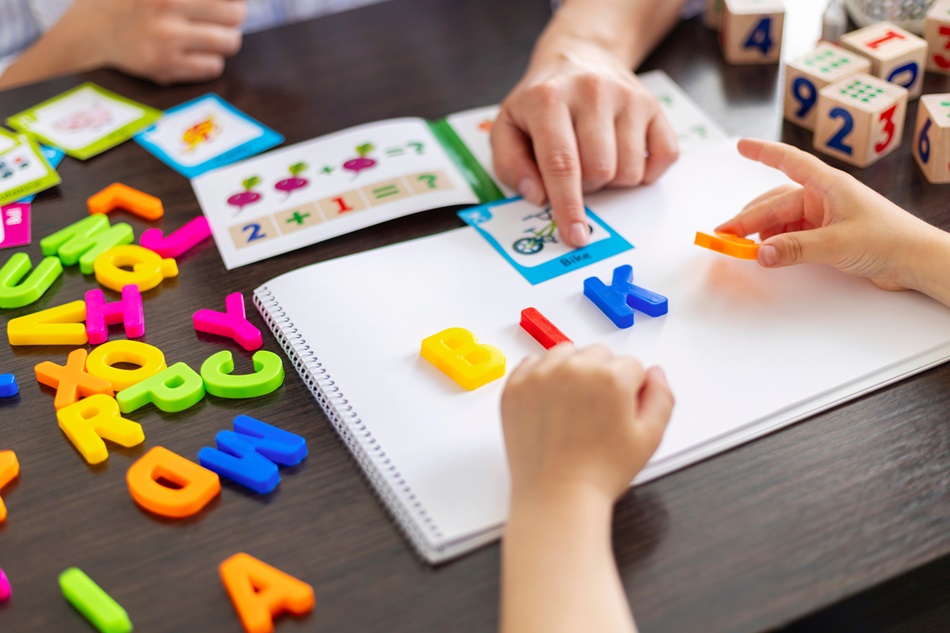
To deepen that learning, pair visuals with hands-on phonics. Try a “Read It, Build It, Write It” routine: students see a word, build it using manipulatives like letter tiles or magnetic letters, then write it down. This sequence reinforces spelling patterns and letter-sound connections through repetition and variation.
Color-coding vowels and consonants or highlighting word patterns can also help students visually organize how words work.
Hearing: Strengthen Sound Awareness
Sound is at the core of reading. Activities that focus on listening and speaking build phonemic awareness, or the ability to hear and manipulate sounds in words.
Read-alouds, rhyming activities, and especially shared reading are highly effective. When paired with audiobooks, students can follow along in the text while hearing fluent reading, strengthening the connection between spoken and written language.
To make this more interactive, have students underline sight words, circle vowel patterns, or listen for specific sounds as they follow along.
Sound mapping is another powerful strategy. Students listen to a word, break it into individual sounds, and represent each sound with a counter or tile. This makes the invisible work of hearing sounds visible and tangible.
Touch & Manipulatives: Make Phonics Concrete
Hands-on learning is essential for many early readers. Manipulatives allow students to physically engage with words, making phonics instruction more concrete.
Word building with letter tiles or blocks helps students practice blending and segmenting. Strengthen their understanding of phonics patterns by letting them build a word, change one sound, and see how the word transforms.
Tactile techniques deepen this experience. Students can trace sandpaper letters while saying each sound, write words in sand or shaving cream, or form letters with playdough. These activities reinforce learning through touch while activating multiple areas of the brain.
Movement: Build Literacy Through Action
Movement-based literacy connects learning to the body, improving both engagement and retention.
Air writing is a simple but powerful tool. Students use large arm movements to “write” letters or words in the air, building muscle memory and reinforcing letter formation.
Tapping out sounds is another effective strategy. Students tap their arm or desk for each phoneme in a word, then blend the sounds together. This physical sequencing supports sound mapping and helps students internalize how words are constructed.
You can also incorporate clapping, stepping, or other movements to represent sounds, turning phonics practice into an active, whole-body experience.
Smell & Taste: Add Memorable Layers
Smell and taste aren’t directly tied to phonics, but they can enhance learning when paired with other strategies.
Students might write letters in scented shaving cream or use scented markers to reinforce letter-sound connections. Taste-based activities like building words with letter-shaped snacks add a fun, memorable element to practice.
These strategies work best as occasional enhancements that make learning feel special and engaging.
What Makes This Effective
To students, these activities might feel like play. But behind the scenes, they’re strengthening critical neural pathways.
Multi-sensory instruction gives students more than one way to access information. Hands-on phonics, manipulatives, sound mapping, tactile learning, and movement-based strategies all work together to deepen understanding and improve retention.
That’s also where having the right tools within reach makes a difference. When hands-on materials, decodable texts, and sound-based activities are organized, accessible, and easy to move between classrooms, it’s much easier to keep instruction consistent and responsive.
Solutions like the Science of Reading Learn & Go™ Cart are designed with that flexibility in mind, bringing together books, manipulatives, and phonics-based resources in one mobile setup that can support multiple classrooms and learning needs. It allows educators to shift seamlessly between word building, sound mapping, and connected reading without losing momentum.

For struggling readers, this can be the key to unlocking progress. For all learners, it makes reading instruction more engaging, effective, and even enjoyable.
When we open multiple “doors” into the brain, we create more opportunities for success, helping every child build a strong, confident foundation in reading.


Leave a Reply